
Nvidia’s RTX Chips: How a Gaming Card Changed the World, and Whether One Makes a Beast for Automated Trading (2026)

Contents
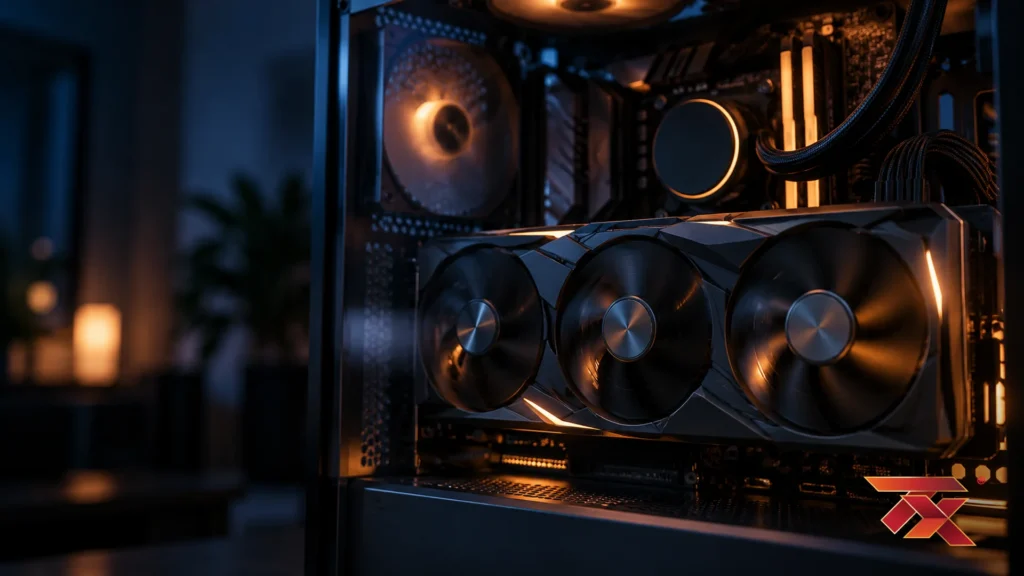
Somewhere in Kuala Lumpur tonight a student is pricing an RTX 5090, a card that costs more than a used Myvi, because a forum post said it would turn their trading bot into a beast. The card is a genuine marvel. It is also, for the trading that student does, almost entirely irrelevant, and understanding why is a better education than the card.
This article tells two stories. First, how a chip built to draw video games became the engine of artificial intelligence and rearranged the world’s largest companies in the process. Second, what a GPU can and cannot do for automated trading, from the MetaTrader bot on a laptop to the hedge-fund simulation farm, so that the money goes where it helps.
📌 Key points
- A GPU does thousands of simple calculations at once. That is why it draws games, and it turned out to be exactly what deep learning, crypto mining and now large AI models needed. Nvidia’s RTX and GeForce line is where that history happened.
- The RTX 50 series, launched in 2025, is still the current consumer generation in late 2026; a 5090 lists at US$1,999 and sells above that. The expected 50 Super refresh is reported shelved and RTX 60 is not expected before late 2027. Nvidia’s data-centre chips, not RTX, made it a US$5 trillion company.
- For automated trading, the honest answer: a GPU helps if you train machine-learning models, run many thousands of backtests at once, or serve an ONNX model inside MetaTrader 5. It does nothing for a typical expert adviser, the built-in strategy tester, or live execution speed.
- The beast in retail automated trading is not the hardware. It is the strategy’s edge and the discipline of the person running it. The fastest machine executes a bad plan faster.
- If you buy one, buy it for a reason the journal supports: a model you have built and tested, not a bot you hope to buy.
What a GPU actually is
A central processor, the CPU in every laptop, has a handful of very fast cores that do one complicated thing after another. A graphics processor has thousands of simpler cores that do the same small thing to a huge amount of data at once. Drawing a game frame is exactly that: colour millions of pixels, every sixtieth of a second. Nvidia named the GeForce 256 “the world’s first GPU” in 1999 and sold it to gamers for a decade.
The turn came in 2006 and 2007, when Nvidia released CUDA, a way for ordinary programmers to use those thousands of cores for anything that could be split into many identical pieces: physics, weather, finance, and, it turned out, the arithmetic of neural networks.
How a gaming card changed the world
2012: deep learning finds its engine. A neural network called AlexNet, trained on two consumer GeForce GTX 580 gaming cards, crushed the field in an image-recognition contest. Researchers discovered that the graphics card in a gaming PC could train networks that supercomputers had struggled with. Every advance in AI since, from speech recognition to translation to the language models of the 2020s, ran on descendants of that card.
2016 to 2022: the crypto years. Mining Bitcoin and later Ethereum rewarded the same parallel arithmetic. GPUs vanished from shelves, prices doubled, and gamers learned to resent miners. Ethereum ended GPU mining in September 2022, and the cards came back; the lesson that a graphics card was a general-purpose money machine stayed.
2018: RTX. The RTX 20 series added two new kinds of core: ray-tracing cores for realistic light, and tensor cores, built for the matrix maths of AI, first used to upscale games with a technique called DLSS. The gaming card now had AI hardware inside it, and the two stories merged.
2022 onward: the AI boom. The large language models needed thousands of GPUs each, and Nvidia’s data-centre chips, Hopper, Blackwell and now Rubin, became the scarcest industrial input in the world. Nvidia’s value passed US$5 trillion in late 2025. The consumer RTX line, the RTX 50 series launched at the start of 2025 with the 5090 at US$1,999 and the 5080 at US$999, became a small, loud sibling: still the best gaming hardware, still above list price in 2026 because the same factories prioritise data-centre chips, and a credible AI workstation in a desktop. In late 2025 Nvidia even sold a US$3,999 desktop AI box, the DGX Spark, for developers who want a small data centre on their desk.
That is how a card for drawing games came to reorder the economy: the parallel arithmetic of graphics turned out to be the arithmetic of intelligence.
The most recent launch, and what is not coming
As at late October 2026 the RTX 50 series, launched at CES 2025 on the Blackwell architecture, is still Nvidia’s newest consumer generation: the 5090 at US$1,999 list, the 5080 at US$999, and the 5070 class below them, all still selling above list in Malaysia because the same factories prioritise data-centre chips. The most recent Nvidia hardware a trader could actually put on a desk is the DGX Spark, a US$3,999 desktop AI system that went on sale in October 2025 for developers who want a small data centre beside the monitor.
What is not coming is the more useful news. A mid-cycle “Super” refresh of the RTX 50 series was widely expected during 2026; reports through October say it has been shelved, with shortages of the GDDR7 memory the cards use cited as the reason. The next generation, RTX 60 on the Rubin architecture that is going into data centres this half, is not expected in consumer form before late 2027 or 2028. Nvidia has confirmed neither the cancellation nor the date, so treat both as reports. The practical consequence for a buyer is simple: there is no new card to wait for, prices are not about to fall, and the only reason to buy now is a model that needs the card now.
What a GPU does, and does not do, for automated trading
Now the question the student actually asked. Automated trading means software placing trades by rules. The rules might be a few lines in an expert adviser on MetaTrader 5, a Python strategy on a broker’s API, or a machine-learning model that predicts the next move. Where does a GPU help?
| Task | Where the time goes | Does a GPU help? |
|---|---|---|
| Running a MetaTrader 5 expert adviser live | Waiting for ticks, then a few microseconds of logic; then the network round-trip to the broker | No. The bottleneck is the internet and the broker’s server, measured in milliseconds a GPU cannot touch. |
| Backtesting an EA in the MT5 strategy tester | Bar-by-bar simulation; MT5 spreads it across CPU cores as “agents” | No. The tester uses CPU cores. More cores help; the GPU sits idle. |
| Optimising an EA’s parameters (hundreds of runs) | Many independent backtests | Mostly no inside MT5; CPU agents. Yes if you rewrite the backtest in Python with GPU libraries and run thousands of variants in parallel. |
| Training a machine-learning model on price data | Matrix arithmetic over large datasets | Yes. This is what tensor cores exist for; training that takes hours on a CPU takes minutes on an RTX. |
| Running a trained model inside MT5 via ONNX | Model inference on each tick or bar | Yes, modestly. MT5’s January 2026 build runs ONNX models significantly faster on CUDA GPUs and lets you choose the device. |
| Institutional simulation (millions of scenarios) | Massive parallel sweeps | Yes, hugely, but at rack scale: Nvidia’s benchmark of about 20 million trading simulations an hour against 3,200 ran on a multi-GPU data-centre system, not a desktop. |
| Getting faster fills than other retail traders | Network distance to the broker | No. That is co-location and a good connection, not a graphics card. |
Read down the table and the pattern is clear. The GPU helps in the research stage, when you are building and training models or sweeping thousands of parameter combinations in Python. It does almost nothing in the execution stage, where a typical retail bot lives. Most Malaysian retail automated trading is an EA on MT5 running on a VPS near the broker; for that setup the single best hardware upgrade is a closer server, not a faster card.
So is an RTX a beast for automated trading?
For a specific kind of trader, yes: someone who writes their own models, trains them on years of tick data, validates them properly and then runs them as ONNX inside MT5 or through a Python pipeline. An RTX 5080 or 5090 turns their overnight training runs into lunch breaks, and that speed lets them test more ideas and discard bad ones faster. That is a real edge in research throughput.
For almost everyone else, no, and the belief that it is causes two expensive mistakes.
Buying hardware instead of an edge. A RM10,000 card does not make a strategy profitable. It runs an unprofitable one faster and with more confidence. Most retail bots lose for the same reasons most retail traders lose: no edge, no risk control, abandoned after the first drawdown. None of those is a compute problem.
Buying a bot instead of a skill. The “AI trading bot” that needs a powerful GPU is a recurring sales pitch, and the Securities Commission’s Investor Alert List has carried AI-branded trading schemes. A legitimate model you built yourself may need a GPU. A black box someone is selling you with a guaranteed return needs a regulator.
The beast, in the end, is the same thing it has always been: a tested edge, a fixed risk per trade, and a trader who follows the rules, whether a human or a program they wrote. We teach that order in U.S.D Trader Camp before anyone writes a line of code, and The Mentored Trader is where students who want to automate take it further, journal first, hardware last.
If you do buy one
- Have the model first. If you cannot say which model you will train and on what data, you do not need the card yet.
- CPU cores and RAM for MT5; GPU for Python. For strategy-tester work, a modern CPU with many cores and plenty of memory matters more. The GPU is for the machine-learning side.
- A 5070 or 5080 class card covers most retail research. The 5090 is for very large models or the pleasure of owning one. Check Malaysian street prices; they ran above list through 2026.
- Put the live bot on a VPS near the broker, not on the gaming PC. Execution lives on the network.
- Log the bot like a human trader. A strategy that cannot explain its trades in a journal is one you cannot fix when it breaks.
FAQ
What is Nvidia RTX?
Nvidia’s consumer and workstation graphics-card line since 2018, named for the ray-tracing cores it introduced. It also carries tensor cores for AI arithmetic. The RTX 50 series, launched in 2025, is the current generation; the RTX 5090 lists at US$1,999.
Do I need a GPU for algorithmic trading?
Not for running or backtesting a MetaTrader expert adviser; those use the CPU and the network. You need one if you train machine-learning models on price data, run thousands of backtests in parallel in Python, or serve ONNX models inside MT5, which has supported CUDA acceleration since its January 2026 build.
Does a better PC make my trades execute faster?
No. Execution speed is the network distance to the broker’s server. A VPS in the broker’s data centre beats any desktop in Kuala Lumpur.
Can an RTX 5090 run an AI trading bot that guarantees profit?
No hardware guarantees profit, and a bot sold with a guaranteed return is a warning sign; such schemes have appeared on the Securities Commission’s alert list. A model you build and test yourself may benefit from the card; a black box does not become legitimate by running on expensive hardware.
What changed the world more, RTX or Nvidia’s data-centre chips?
The same technology, different scale. Consumer GeForce cards started deep learning in 2012; the data-centre chips, Hopper, Blackwell and Rubin, carried the AI boom and Nvidia’s US$5 trillion value. RTX is the version that fits under a desk.
Summary
A GPU does thousands of simple calculations at once, which drew video games, then trained the first deep-learning networks on gaming cards in 2012, mined crypto, and now runs the AI boom on Nvidia’s data-centre chips, with the RTX 50 series as the consumer sibling. For automated trading the card helps in research, training models, parallel backtests in Python, ONNX inference in MetaTrader 5, and does nothing for a normal expert adviser, the strategy tester or execution speed, which is a network problem. An RTX is a beast for a trader who builds and tests their own models. For everyone else, the beast is a tested edge and the discipline to run it, which costs nothing and is harder to buy.
Disclaimer
This article is education, not financial advice. Hardware prices and software capabilities are as published at the time of writing and change. Automated trading carries the same risks as manual trading plus software and connectivity risk; most retail traders lose money. Traderpreneur Xcellence Sdn Bhd is a trading education provider and does not provide investment advice, trading signals or account management.
Related reading
- Nvidia’s Rubin: A Game Changer for AI Tokens?
- Do More Indicators Guarantee Results?
- Complicated Strategy or Stable Mindset: Which Matters More?
- Not Sure What Your Trading Style Is? Your Trade Journal Already Knows
- The Mentored Trader · U.S.D Trader Camp
- 中文版 Chinese version: 英伟达 RTX 芯片:一张游戏显卡怎么改变了世界,它是自动交易的猛兽吗?
Further Reading
- The Fed Chair Said Money Is “Tighter, but Not Tight”. What That Means, and Why It Decides Whether Your Stocks Go Up (2026)
- America’s Inflation Is “Too High” Because of Oil. So Why Is Petrol Still RM1.99 in Malaysia? (2026)
- “82% Chance of a Rate Hike”: Who Decides That Number, and How to Read It Before You Trade (2026)
- The New Fed Chair Says He Won’t Tell Markets What Comes Next. What That Means for Your Gold and Forex Trades (2026)
TX Signature Program
New to trading? Start with U.S.D Trader Camp
Our beginner entry program: an in-person class in Kuala Lumpur from RM68, where you learn to read the market, trade with rules and scale with a plan. Weekly Zoom reviews and mentor support included.