
Data Centres in Malaysia: How Johor Became Asia’s Fastest-Growing Hub, and What It Does for Foreign Investment (2026)

Contents
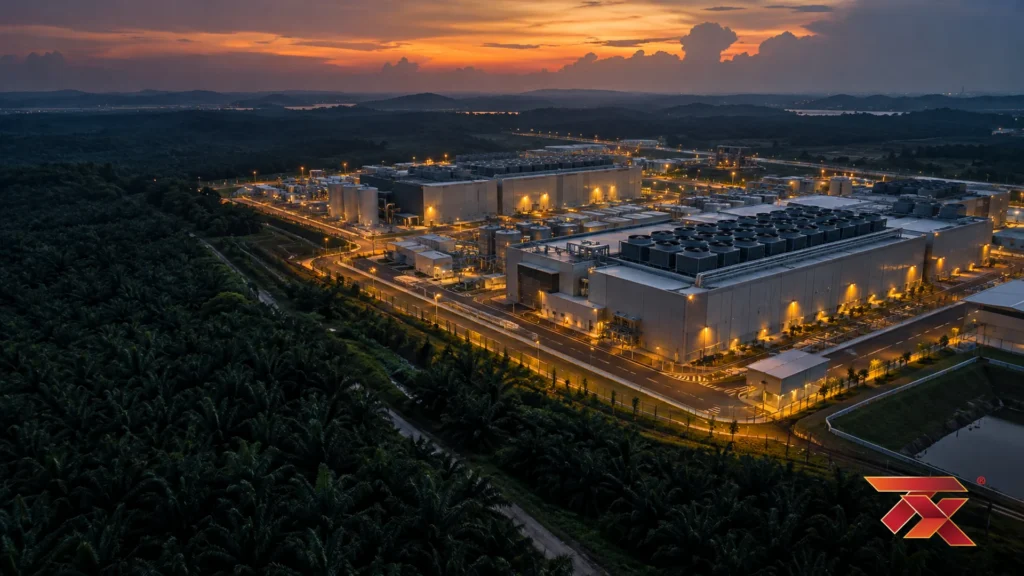
Five years ago Johor’s data-centre capacity barely registered. In 2026 it has 1,110 megawatts of live IT capacity, more than Singapore, third in the whole Asia-Pacific behind only Tokyo, and a pipeline of 8,542 megawatts, the largest in the region. Microsoft, Google, Amazon, Oracle, ByteDance and Nvidia’s partners have all committed billions. Vacancy in Johor’s co-location halls is 0.7%, which is to say there is none.
This article explains how that happened, who is building what, what it actually does for Malaysia’s foreign investment and economy, the power-and-water catch that has started to slow approvals, and what it means for the markets a Malaysian trader watches.
📌 Key points
- Johor is now the third-largest data-centre market in Asia-Pacific by live capacity (1,110 MW) and the largest by pipeline (8,542 MW), with near-zero vacancy.
- The trigger was Singapore’s shortage of land and power, a 20-minute drive away. Johor had land, cheaper power and water, and from 2025 a special economic zone with Singapore.
- Data centres bring large, fast, foreign capital: billions committed by the US hyperscalers and Chinese and Australian operators, and tens of billions of ringgit in approved investment in single quarters.
- The catch is that a data centre employs few people per ringgit and consumes enormous power and water. Approvals are now conditional on both, and new tariffs have raised running costs.
- For markets: the boom runs through utilities, construction, industrial REITs and the ringgit’s capital inflows, and it is tied to the same AI spending cycle that drives the NASDAQ.
How Johor became a hub
The story starts across the causeway. Singapore, the region’s original data-centre capital, ran out of power and land and imposed a moratorium on new builds from 2019 to 2022, lifting it only for small, efficient projects. The hyperscalers, the cloud giants whose demand was exploding, needed capacity near Singapore’s network hub. Johor was twenty minutes away, with industrial land, a cheaper and more available power supply, water, and a government that wanted the investment.
Three things turned interest into a boom. Cheaper inputs: land and electricity in Johor cost a fraction of Singapore’s. The AI cycle: from 2023 the demand for computing power for artificial-intelligence models multiplied what every cloud provider needed, and Malaysia was ready when the orders came. Policy: Malaysia courted the builders, and in January 2025 Malaysia and Singapore signed the Johor-Singapore Special Economic Zone agreement, giving investors a framework to treat the two sides as one market.
By 2026 Knight Frank’s regional atlas records Johor’s live capacity at 1,110 MW against Singapore’s 1,118 MW and Tokyo’s 1,473 MW, and a pipeline of 8,542 MW that no other Asia-Pacific market approaches.
Who is building what
| Investor | Commitment | When announced |
|---|---|---|
| Microsoft | US$2.2 billion for cloud and AI infrastructure; Malaysia West region in Greater KL now live, a Johor region planned | May 2024 |
| US$2 billion for its first Malaysian data centre and cloud region | May 2024 | |
| Amazon Web Services | US$6.2 billion through 2038 | 2023 |
| Oracle | US$6.5 billion for a cloud region | October 2024 |
| ByteDance (TikTok’s parent) | About RM10 billion for AI data centres | 2024 |
| YTL with Nvidia | RM20 billion AI data centre in Kulai, Johor | December 2023 |
| An Australian hyperscale operator | RM12.7 billion for two Johor data centres adding 280 MW | 2026 |
Around those anchors sit the local developers and landlords who build the shells: industrial estate owners in Sedenak, Kulai and Nusajaya, construction groups, and the power and water utilities that connect them. In the first half of 2026 alone Johor recorded RM1.02 billion of disclosed data-centre land and property deals across 66 hectares.
What it does for foreign investment
Three things, in descending order of how often they are mentioned and ascending order of how much they matter.
The headline number. Data centres are now one of the largest single categories in Malaysia’s approved investment figures. One report put approvals at RM34.6 billion across 33 data-centre and cloud projects in the first quarter of 2026 alone. Few industries bring capital that fast or that visibly.
The ecosystem. A hyperscale region is sticky. Once Microsoft or Google runs a region from Malaysia, the companies that build on their clouds, the cables that connect them, the engineers who maintain them and the power plants that feed them follow. That is the argument for the special economic zone: Malaysia as the capacity next door to Singapore’s finance.
The signal. For foreign investors deciding where to put a factory or a regional office, the presence of the world’s largest technology companies is evidence that the power grid, the regulation and the politics are workable. The data-centre boom is partly a marketing campaign Malaysia did not have to pay for.
The catch: power, water and jobs
The same report that counts the megawatts counts the cost.
- Power. A 50 MW data centre draws as much electricity as a small town, continuously. New electricity tariffs in 2026 add up to RM120 million a year to the running cost of a facility that size, narrowing Johor’s cost advantage over Singapore.
- Water. Cooling the halls uses water Johor also sells to Singapore and needs for its own growth.
- Jobs. A data centre employs a few hundred people once built, far fewer per ringgit invested than a factory. The investment figure flatters the employment figure.
- Approvals. The government has started to say no, or not yet. The trade ministry’s position in 2026 is that projects are approved only after energy and water capacity is confirmed sufficient. The boom has hit a capacity wall of its own.
None of this reverses the story. It changes it from “unlimited” to “rationed”, which usually means the best-placed operators and landlords win and the speculative ones do not.
What it means for a Malaysian trader
The boom is not a chart you trade directly, but it runs through several that you do.
- Utilities and construction on Bursa. Power producers, grid operators, water companies and the contractors that build halls are the domestic beneficiaries. Their results now move with data-centre approvals and tariff decisions.
- Industrial REITs. Warehouses and data-centre shells are the favoured property sector of the decade, which is part of why industrial trusts have outperformed; our REIT decade review covers it.
- The ringgit. Billions in foreign commitments are capital inflows. They are one of the structural supports under the ringgit’s 2026 range, alongside interest rates and the current account.
- The NASDAQ link. Every megawatt in Johor exists because of the same AI spending cycle that drives Nvidia, Microsoft and Google’s share prices. If that cycle slows, Johor’s pipeline slows with it. A Malaysian trading the NASDAQ 100 and a Johor landlord are, in that sense, on the same trade.
FAQ
How big is Malaysia’s data-centre industry?
Johor alone has 1,110 MW of live capacity in 2026, third in Asia-Pacific after Tokyo and Singapore, and an 8,542 MW pipeline, the region’s largest. Vacancy is 0.7%.
Which companies have data centres in Malaysia?
Microsoft, Google, Amazon Web Services, Oracle, ByteDance and YTL with Nvidia have committed billions, alongside Australian and regional co-location operators and local developers in Sedenak, Kulai and Nusajaya.
Why is Johor so popular for data centres?
It is twenty minutes from Singapore’s network hub, with land, power and water that Singapore ran out of, cheaper costs, and since 2025 a special economic zone with Singapore.
Do data centres create jobs in Malaysia?
Relatively few directly: a few hundred per facility once built. The economic case rests on capital inflows, the cloud ecosystem that follows, and the signal to other investors, not on employment.
Is the boom slowing?
Approvals are now conditional on power and water capacity, and new tariffs have raised running costs. The pipeline is still the region’s largest; the pace of approvals is being rationed.
Summary
Johor went from nothing to Asia-Pacific’s third-largest data-centre market in five years, with 1,110 MW live, an 8,542 MW pipeline and no vacancy, because Singapore ran out of land and power, the AI cycle multiplied demand, and Malaysia courted the builders and signed a special economic zone with Singapore. The hyperscalers have committed billions, and data centres are now among the largest categories in approved foreign investment, bringing an ecosystem and a signal as well as capital. The catch is power, water and thin employment, which has turned approvals from open to rationed. For traders the boom runs through utilities, construction, industrial REITs, the ringgit and the same AI cycle that drives the NASDAQ.
Disclaimer
This article is education, not financial advice. Capacity, investment and approval figures are from industry research and news reports as at the time of writing; some approval figures are reported rather than official and are labelled as such. Trading leveraged products carries a high risk of losing money, and most retail traders lose. Traderpreneur Xcellence Sdn Bhd is a trading education provider and does not provide investment advice, trading signals or account management.
Related reading
Further Reading
- The Fed Chair Said Money Is “Tighter, but Not Tight”. What That Means, and Why It Decides Whether Your Stocks Go Up (2026)
- America’s Inflation Is “Too High” Because of Oil. So Why Is Petrol Still RM1.99 in Malaysia? (2026)
- “82% Chance of a Rate Hike”: Who Decides That Number, and How to Read It Before You Trade (2026)
- The New Fed Chair Says He Won’t Tell Markets What Comes Next. What That Means for Your Gold and Forex Trades (2026)
TX Signature Program
New to trading? Start with U.S.D Trader Camp
Our beginner entry program: an in-person class in Kuala Lumpur from RM68, where you learn to read the market, trade with rules and scale with a plan. Weekly Zoom reviews and mentor support included.